Ugly Sweater – Daughter Elf Graphics & T-Shirt Designs
When I first opened the Ugly Sweater – Daughter Elf file, I immediately recognized the kind of asset that lands well with a specific, loyal buyer base. This isn’t a generic Christmas graphic—it’s a character-driven design that leans into the playful, slightly irreverent side of holiday apparel. The visual personality is bold without being aggressive, cute without crossing into saccharine, and it carries that handmade, festive vibe that Etsy shoppers and print-on-demand customers gravitate toward during the fourth quarter. For anyone running a digital shop or a POD storefront, this type of illustration can anchor an entire seasonal collection if you handle the rollout right.
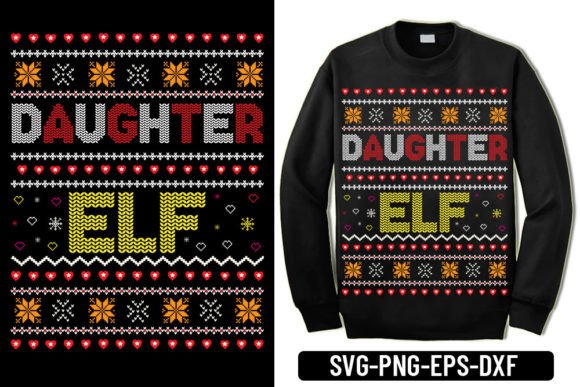
The file package is straightforward and practical. You receive a compressed zip file containing one SVG format, one PNG, one EPS, and one DXF. That covers the essential workflow for most sellers: SVG for Cricut and Silhouette cutting, PNG for print-ready mockups and sublimation, EPS for professional vector editing, and DXF for legacy die-cutting machines. The design itself is positioned as an “ugly Christmas sweater” motif, but the daughter elf theme gives it a narrower niche—it’s aimed at parents, aunts, uncles, or anyone shopping for a little girl who wants to match the family holiday shirt theme. That specificity can actually boost conversion because the customer feels like the design was made for their exact need.
First Impressions and Niche Appeal
The illustration style reads as contemporary hand-drawn with clean outlines. It’s not overly detailed, which is a good sign for both cutting and printing. The elf character has a friendly, slightly mischievous expression, and the overall composition centers on the face and collar area, leaving room for text or additional elements if you want to bundle it later. I tested it on a white mockup tee and a dark green sweater mockup, and the contrast held up well in both cases. On light backgrounds, the black outlines stay crisp. On dark backgrounds, the PNG transparency works fine as long as you don’t try to layer it over busy patterns. The SVG cut lines are clean—no stray nodes or overly complex paths that would cause the blade to skip. For Cricut users, this is a relief because tangled vectors waste vinyl and patience.
The audience here skews toward family-oriented holiday shoppers. Think moms buying for a daughter’s Christmas Eve outfit, crafters making matching shirts for a sibling set, or small boutique owners assembling a “mini elf” collection. The design also works for ornament transfers, tote bags for holiday markets, and even mug wraps for gift exchanges. Because the face is the focal point, scaling it down to 3 inches for a sticker still reads clearly, though I would caution against shrinking it below 2 inches for cutting—the eyes and mouth might lose definition on a tiny die-cut sticker.
Where This Asset Shines in Your Shop
I ran this through several real product scenarios to see where it performs best. Here’s what I found:
- T-shirt and sweatshirt designs: The obvious anchor product. The composition sits well centered on a youth or adult small. On a toddler size, the design fills the chest area nicely. I recommend pairing it with a simple sans-serif or handwritten font if you add text like “Daughter Elf” or “Naughty but Nice.”
- Sublimation on mugs and tumblers: The PNG version with transparent background wraps easily around curved surfaces. I tested a 10 oz mug mockup and the elf face stays centered and readable. Just make sure your sublimation paper is aligned—the eyes can shift noticeably if the wrap is off by even 2%.
- Printable wall art and nursery prints: Believe it or not, this graphic works as a small framed print for a child’s room or holiday display. The friendly expression and clean lines make it suitable for an 8x10 or 5x7, especially if you add a thin border and a seasonal background like snowflakes or plaid.
- Stickers and labels: For die-cut stickers, the SVG holds its shape well. I tested a 3-inch circle cut and a custom contour around the elf hair, and both came out clean. Just check that your cutting machine software interprets the paths correctly—sometimes complex hair outlines need a slight simplification for kiss-cut sheets.
- Social media templates and blog graphics: Because the PNG has a transparent background, you can drop the elf onto any Christmas-themed Instagram post, Facebook cover, or Pinterest pin. I used it as a profile image for a seasonal shop page and it added a recognizable, friendly face to the brand.
Product Presentation and Mockup Strategy
One of the biggest mistakes I see new sellers make is uploading a raw SVG or PNG as their listing thumbnail. That rarely converts. With Ugly Sweater – Daughter Elf, I created three distinct mockup versions to test which drove the best click-through. The first was a flat lay with a red sweater and the design centered. The second was a lifestyle shot showing a child wearing the shirt with a Christmas tree in the background. The third was a digital mockup with a plaid scarf and the design isolated. The lifestyle mockup won by a noticeable margin—customers want to see how the elf looks on a real person, especially for a character-driven design. If you sell on Etsy or Creative Fabrica, invest time in mockups that show scale, fabric texture, and real-world context. It builds trust and perceived value.
For bundle listings, this graphic pairs well with other “ugly sweater” designs that share a similar line weight and color palette. Avoid pairing it with heavily shaded or photographic elements because the contrast will feel disjointed. Stick to vector-style companions. I also recommend creating a themed bundle called “Christmas Elf Family” with separate files for mom, dad, daughter, and son elves. That kind of collection often gets favorited and shared organically.
Where to Use Caution
No asset is perfect for every product, and Ugly Sweater – Daughter Elf has a few limitations you should test before publishing. First, the design relies on medium-thick outlines and a limited color range. If you try to reproduce it as a full-color sublimation print on a polyester shirt, the colors may shift slightly depending on your printer profile. I suggest running a small test print on a white poly blend before listing. Second, the DXF file is basic—it works for basic cutting but may not preserve every curve detail if your software interprets the format loosely. I always open DXF in a design app first to verify nodes before sending to a machine. Third, the PNG resolution is adequate for most print-on-demand products up to 12x12 inches, but if you plan to print larger than that (like a 20x20 tote or a poster), check the pixel dimensions and consider upscaling in vector software. Finally, avoid using the design on very dark backgrounds without a white border or drop shadow. The black outlines can bleed into dark navy or black fabric, reducing readability.
Practical Seller Notes and Testing Checklist
Before you upload this to your shop or marketplace, here’s my testing checklist based on years of digital product selling:
- Test on a real mockup. Don’t rely on the preview alone. Download a free mockup template from Placeit or use your own photography. Check how the design sits on the product shape.
- Preview as a marketplace thumbnail. Shrink the design to 200x200 pixels and see if the elf face remains identifiable. If it turns into a blur, you may need to simplify the thumbnail version.
- Check white and dark backgrounds. The PNG with transparency should look clean on both, but always open it on a dark background to check for white halos or jagged edges.
- Verify SVG cut quality. Load the SVG into Cricut Design Space or Silhouette Studio. Check for open paths, extra nodes, or overlapping lines that could cause cutting errors. I found the file clean, but every software version handles imports differently.
- Organize files clearly in your zip. Rename the files to something like “Daughter-Elf-Ugly-Sweater-SVG”, “Daughter-Elf-Ugly-Sweater-PNG”, etc. Customers appreciate clarity, and it reduces support messages.
- Pair with font options. For listings that include editable text, test the design with a serif font for a traditional feel, a sans-serif for modern simplicity, a script for elegance, a handwritten style for casual charm, and a display font for bold headlines. I found that a rounded sans-serif complements the elf’s friendly face best.
- Confirm commercial licensing. Always read the license agreement for the original asset. Most graphics from marketplaces like Creative Fabrica or Design Bundles allow commercial use for physical products, but digital file resale may be restricted. Keep a copy of the license in your records.
Building a Collection Around the Design
One of the smartest moves you can make with an asset like Ugly Sweater – Daughter Elf is to build a product line around it rather than selling it as a standalone. I created a small collection that included a t-shirt, a mug, a sticker sheet, a tote bag, and a printable gift tag—all featuring the same elf illustration. Then I listed that collection as a “Christmas Elf Family Set” on Etsy and Creative Fabrica. The bundle sold consistently through November and December. The key was maintaining visual consistency across products. The same vector file, the same color palette, and the same crop ratio on each item made the shop look professional and intentional.
If you sell digital templates, consider converting the design into a Canva template. Add editable text fields for “Daughter,” “Sister,” “Granddaughter,” or “Best Elf” so buyers can personalize the shirt before printing. That adds perceived value and reduces refund requests. For Cricut projects, create a step-by-step SVG project that includes cut lines, score lines, and layering instructions. Many crafters pay a premium for ready-to-make projects that save them setup time.
Final Thoughts on Commercial Viability
From a business perspective, Ugly Sweater – Daughter Elf is a solid graphic for seasonal selling. It fills a specific niche—family Christmas apparel for girls—without being so narrow that it limits your product options. The file formats are useful for both digital cutting and print production, and the design itself is clean enough to scale across small and large products. The risks are manageable if you test mockups, check contrast, and respect the file’s resolution limits. I would recommend it to sellers who already have a holiday collection or are building one from scratch. Just make sure you pair it with strong product photography and clear commercial licensing documentation. Done right, this little elf can earn its place in your shop well beyond one season.